
Structured cyber resilience for operational technology (OT): measurable, evidence-based, and built for industrial environments.
When cyber compromise can affect physical processes, shutting down plant, releasing hazardous materials or disabling safety systems, standard IT security approaches are not enough. OpenPSM® provides a practical, CAF-based methodology for assessing and improving cyber resilience maturity across operational technology environments, with a clear pathway from baseline hygiene toward IEC 62443-aligned industrial cyber security.
Unlike general IT tools, OpenPSM® is built around the unique operational, regulatory, and safety challenges of OT environments. It provides systematic, evidence-based assessments of cyber maturity, actionable improvement plans prioritised by operational and safety risk, and a structured pathway from baseline hygiene to mature industrial cyber security. This helps organisations close gaps fast, demonstrate governance, and avoid the consequences of inaction.
We need all organisations to see cyber security as both an essential foundation for their operations and a driver for growth, to view cyber security not just as a ‘necessary evil’ or compliance function but as a business investment, a catalyst for innovation and an integral part of achieving their purpose. It’s not enough any more to talk about being resilient. We must all take the crucial steps that bolster our defences, that improve and grow our capability to contest.
Dr Richard Horne, CEO, National Cyber Security Centre (NCSC)
01
Why OT cyber risk is different
Operational technology controls physical processes. When it is compromised, the consequences go well beyond data loss or service disruption. They can endanger lives, damage the environment, destabilise production, and disable the safety systems designed to prevent catastrophic events.
This is what makes OT cyber security fundamentally different from IT security, and why approaches designed for corporate networks consistently fall short in industrial environments.
Most IT-centric cyber tools are not designed to account for:
- Safety-critical functions where cyber failure can directly cause physical harm
- Legacy operational technology with long asset lifecycles and limited patching windows
- Engineering realities where availability is often prioritised over security
- Cyber-physical consequences, including latent faults in safety systems that persist after network restoration
- Operational continuity constraints that limit what security measures can practically be applied
Organisations operating industrial OT therefore need an approach that is structured, measurable, risk-informed and designed for the realities of industrial operations, not adapted from an IT security framework.
02
Threat to industrial OT is accelerating
Attacks span every industrial sector: chemicals, water, energy, food production, pharmaceuticals and critical infrastructure.
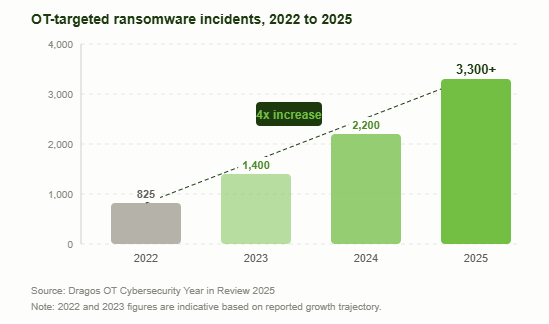
Unlike IT incidents, OT attacks can cause process instability, trigger environmental releases, create latent safety system faults and destroy physical assets.
HSE inspections across high-hazard sites have found governance gaps, weak detection and recovery maturity, and insufficient security-by-design across OT environments, consistently.
Technical controls alone are not sufficient. The regulatory direction of travel is toward demonstrable, evidence-based cyber resilience.
03
What a structured approach actually looks like
Our methodology is built on the NCSC Cyber Assessment Framework (CAF): a nationally recognised structure for assessing cyber security outcomes across four objectives, managing risk, protecting against attack, detecting events, and minimising impact. Each objective is assessed through Contributing Outcomes and Indicators of Good Practice, giving a clear, repeatable picture of where you are and where gaps exist.
The CAF was originally developed for Operators of Essential Services, but its structure makes it equally valuable for any organisation that needs a rigorous, evidence-based approach to cyber security governance, including industrial operators without a formal regulatory mandate.
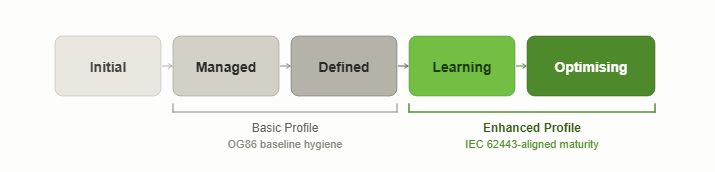
We define two target states, basic and enhanced:

04
Our 5 stage Maturity Model
In our model, the Basic Profile sits between the Managed to Defined stages, and our Enhanced Profile sits between Learning to Optimising.
Our methodology is designed for any organisation operating industrial OT where cyber compromise could cause physical, environmental or operational harm. The regulatory context varies. The challenge does not.

Designed to be defensible in the most demanding regulatory environments, which means it more than meets the bar for any industrial operator.
05
The six-stage assessment process:

06
How OpenPSM® operationalises it
OpenPSM® is a governance and assurance platform that operationalises the methodology above, providing CAF-aligned assessments, structured action management, evidence tracking and reporting in a single software-driven process designed for OT environments.
Assessments are evidence-based and repeatable. Actions are sequenced by risk and urgency. Progress is tracked against defined maturity targets. Governance is maintained in a form that supports regulatory inspection, board oversight and continuous improvement.
- Training and consulting: in-house support to help teams get started, address specific gaps or build cyber leadership capability
- CAF-aligned assessments: structured across all four CAF Objectives, with OT-specific interpretation informed by OG86
- Maturity dashboards: current and target state visibility by CAF Principle across your OT environment
- Prioritised improvement planning: an integrated algorithm sequences actions by impact and urgency, making the path to resilience clear and manageable
- Reporting and evidence management: governance-ready outputs for regulators, boards and inspectors
08
Get in touch today
If you are unsure whether your organisation can demonstrate structured, evidence-based OT cyber resilience management, it may be time to take a closer look.
Call 0161 509 9392 or contact us to learn more about how OpenPSM can help.
If you’re unsure whether your company can confidently demonstrate all the indicators of good hazard leadership, perhaps it’s time to find out more about OpenPSM®. Get in touch today. Call 0161 509 9392 or click the link below.